Why Won’t My Refrigerator Drawer Seal?
Written by
Elena Sandoval
Refrigeration technician — cabinet, door and seal work · 24 years in the trade
Checks seal geometry and door closure first on a warm-cabinet call. A unit fighting a poor seal all day makes the sealed system read badly, and the readings only mean anything once the door is closing the way it was built to.
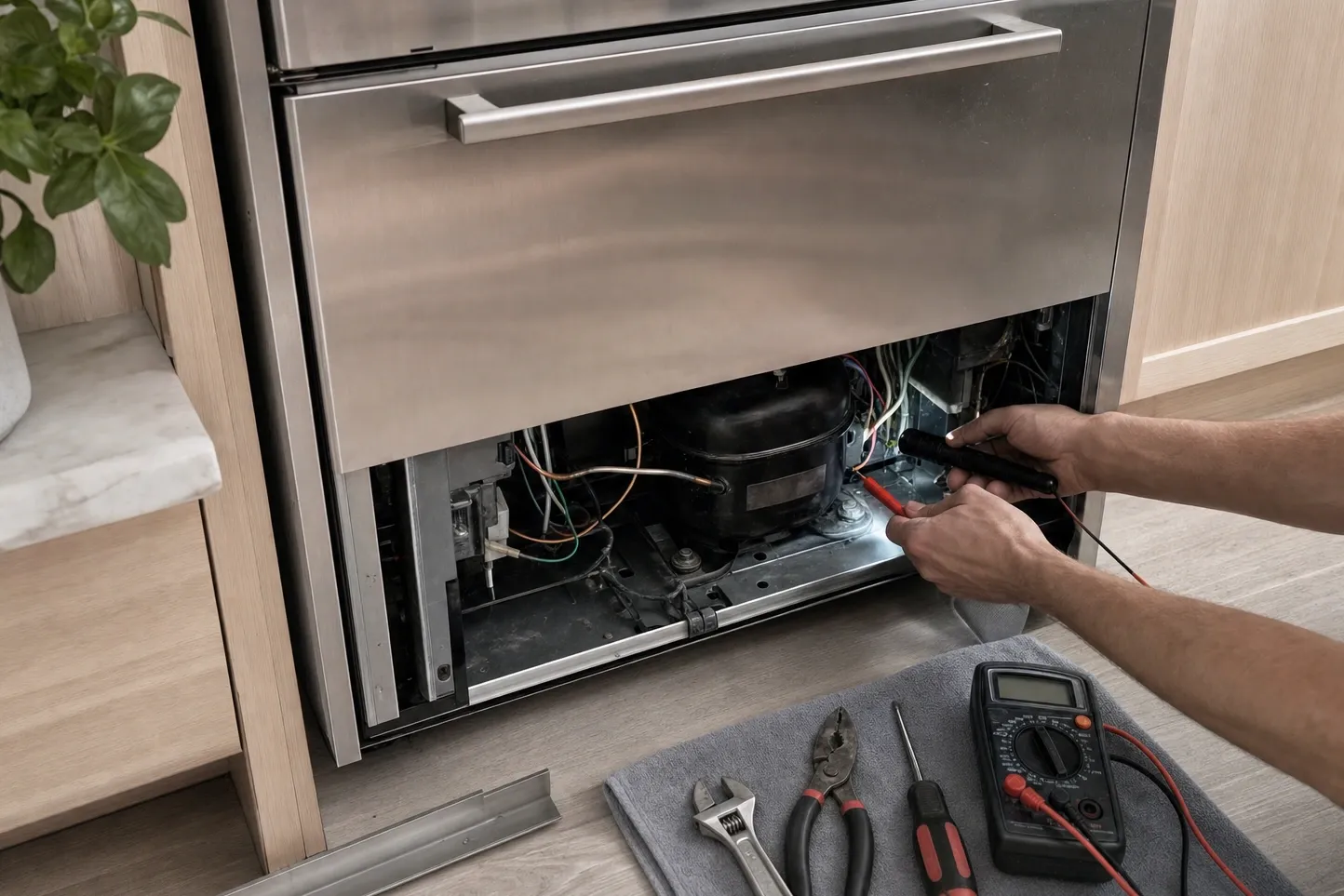
Sub-Zero makes refrigerator drawers and freezer drawers as undercounter units, in stainless or panel-ready fronts, and in plenty of kitchens around here they are the cold storage people actually use all day. They also fail differently from a door, which is why advice written for a door tends to miss.
A drawer is a door lying down
Hang a door and gravity works along its face, pulling it down towards the floor and into the seal on one side. Lay the same panel flat, put it on a pair of runners and push it, and gravity now bears straight down on the running gear while your hand supplies whatever force closes it. Nothing pulls a drawer square. It arrives square only if the two sides carrying it are still travelling at the same rate.
That single difference explains most of what follows. A tired door sags. A tired drawer goes crooked, and a crooked drawer touches its seal on one side while daylight sits on the other.
The runners, and what they collect
Running gear in a cold, damp, frequently-opened compartment picks things up. A spill that dried. Crumbs. A film of grease carried in on packaging. In a freezer drawer, a rime of ice that builds in the same spot each week and melts into the same spot each time the compartment defrosts.
The symptom is not usually a noise. It is a drawer that needs a firmer shove than it used to, or one that comes home fine when empty and stops short when loaded. Both say the same thing: the two sides are no longer moving together, and the front is finishing its travel at an angle.
A seal that meets a frame on four sides
The moulding round a drawer front has a harder job than the one round a door. It has to meet a frame on all four edges, including the bottom one, which is the edge nothing is pressing against once the drawer stops moving. There is no hinge drawing that corner in.
So a small deformation matters more here. A flat spot where a drawer has stood against a warm-room load, a corner that has lost its spring, a section standing a little away from its channel — any of them leaves a path for room air, and room air in a cold box turns into damp first and frost second.
What is inside pushes back
The commonest cause of a drawer that will not seal is not a part at all. It is a jar standing one row too far back, a box of something rigid resting against the rear wall, a bag that slumped sideways when the drawer last came out. The drawer stops a few millimetres early and the front, which is what your eye reads, still looks almost shut.
Empty it before you conclude anything else. A drawer that seals perfectly when empty and refuses when full has told you where to look, and the answer is in the packing rather than in the hardware.
What to check, and what to say
Take out the contents, wipe the visible seal with warm water, and close the drawer on a strip of paper at four places — each side, front edge, back edge — pulling each one straight out. A strip that drags is a seal doing its job. A strip that slides out freely marks the gap.
Then look at the front against whatever sits next to it. Level, or one end proud? A drawer that is proud at one end is reporting its runners, not its seal, and fitting a new moulding to it would only produce a new moulding that wears out in the same corner.
Follow-ups
- Why does the drawer above seal perfectly and the one below not?
- Because each has its own runners and its own weight to carry, and the lower one usually carries more. Whatever is heaviest in a kitchen ends up low down, so the lower pair wears first and the two stop agreeing with each other long before either of them looks wrong.
- There is a fine frost along the back of the drawer. Is that the seal?
- Very often, yes. Frost is room air arriving somewhere cold and leaving its moisture behind, and a drawer that is resting rather than sealing lets a small amount in every hour. Clear it, run the paper strip round all four sides, and note where the paper slides out freely.
- Can I take the runners out and clean them myself?
- Emptying the drawer and wiping what you can reach is sensible and often enough where the cause is a spill that has dried. Removing the running gear is not an owner job: it is what holds the front in alignment, and a drawer refitted a fraction out will seal worse than before.
- How do I describe it when I ring?
- Say whether it seals when empty, which side the paper comes out loose on, and whether the front sits level with its neighbour. Sub-Zero Repair Service Los Angeles, (310) 499-2240, and the $89 it costs to find out covers a technician reading all three before anything is dismantled.