Why Is My Sub-Zero Door Sagging?
Written by
Elena Sandoval
Refrigeration technician — cabinet, door and seal work · 24 years in the trade
Checks seal geometry and door closure first on a warm-cabinet call. A unit fighting a poor seal all day makes the sealed system read badly, and the readings only mean anything once the door is closing the way it was built to.
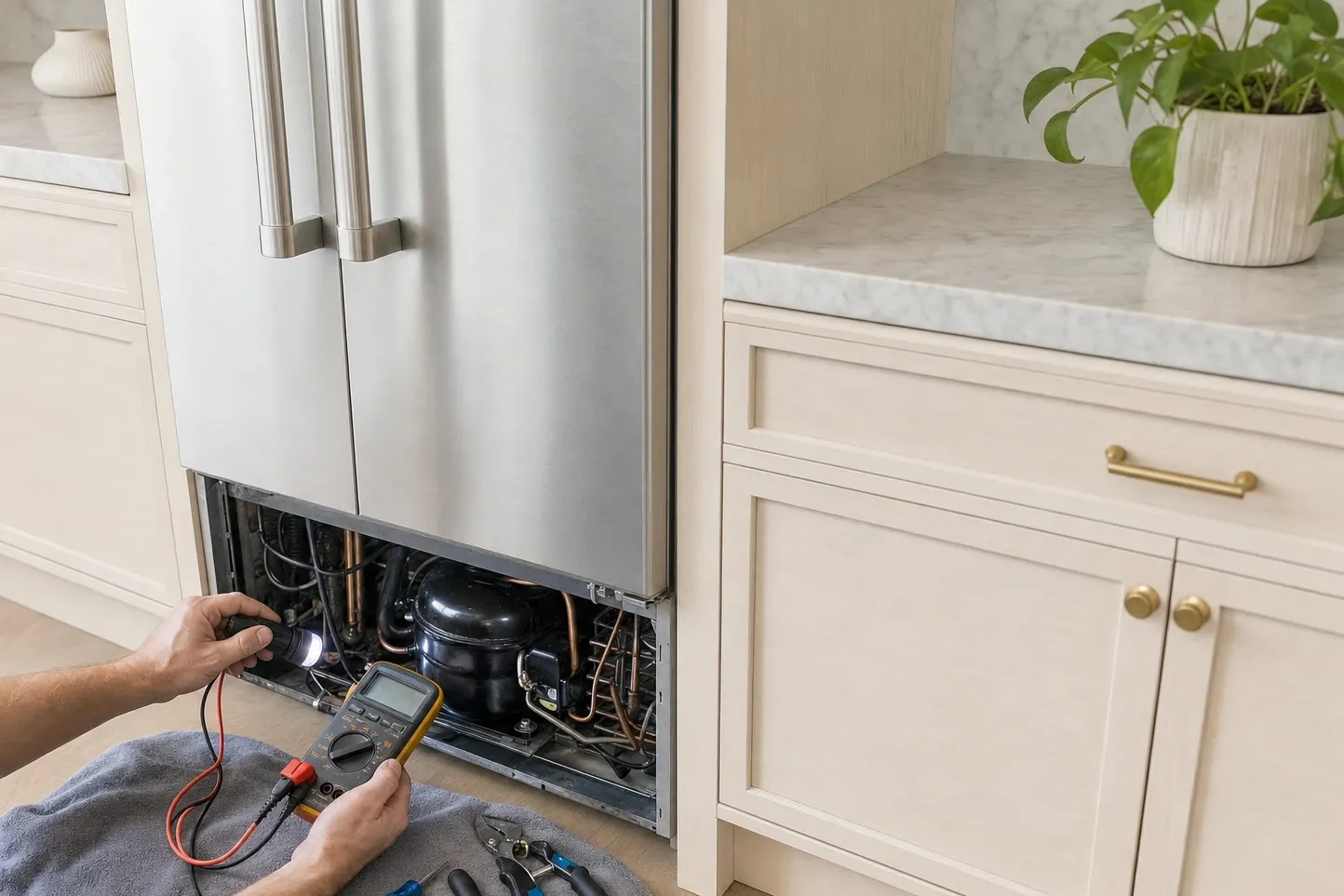
Sagging is the word owners reach for when a door has stopped matching the one beside it. Nothing has broken, nothing sounds wrong, and the fridge simply sits slightly askew in a run of cabinetry that was dead level the week the kitchen was handed over. What has happened is mechanical and unglamorous: the door now weighs more than the fixings can hold precisely where they were set.
Reading it from two paces back
Stand where you would stand to photograph the kitchen rather than up close. Three things give it away.
The gap along the top of the door is no longer an even width end to end. Handles that used to line up with each other, or with a drawer alongside, have stopped lining up. And the door lands unevenly — you can hear it touch at one corner a fraction before the rest of it arrives.
Where a run holds two doors, or two columns, they check each other for nothing. Compare the gap above each door at both ends using a folded card as your gauge. A difference you can see with a piece of card is a difference the seal has been putting up with for months.
A hinge holds whatever was on the door that afternoon
The pivots at the top and bottom of a built-in door are adjusted during installation, and they are adjusted around the door as it stood that day: bare, or wearing whatever front the joiner had already hung on it. The setting is not a guess, but it is a setting, and it assumes the load stays roughly what it was.
Geometry does the rest. The door is a cantilever, hanging out in front of its pivot, so weight added towards the handle end counts for far more than the same weight added near the hinge. That is why alterations nobody thinks of as structural turn up months later as a door sitting low.
What gets heavier after the kitchen is finished
- a replacement front in a denser timber, or a thicker slab of the same species
- stone, glass or metal facing added to a panel originally made for veneer
- an extra finish applied on site, which adds mass and takes up moisture with the seasons
- a substantial handle, acting right at the end of the lever
- door shelves loaded with bottles, which is weight the hinge feels every time the door swings
Houses around Toluca Lake and Burbank meet this more often than most. They are compact, the kitchen gets refaced while the built-in stays, and each refacing hangs a slightly different weight on the same door.
What a dropped door does to the seal
Contact is the whole purpose of a seal, and contact depends on the door arriving square. On a door that has settled, the top corner at the handle side stops touching altogether while the corner diagonally opposite is compressed harder than it was ever meant to be. Cold air escapes at one end, moisture walks in at the same place, and the compressed corner takes a permanent flat. Fit fresh moulding without correcting the hang and it fails in exactly the same spot, only sooner, because it started out being crushed.
Why the adjustment is not a homeowner job
The fixings are carrying a loaded door. Loosen one with the front still attached and the door can travel further and faster than anybody expects, which is bad for the door, worse for the cabinetry edge beside it, and occasionally bad for a hand. On a Designer Series column the hinges are concealed behind the front anyway — Sub-Zero describes hidden hinges as what gives those cabinets their flush appearance — so there is nothing on the outside to turn even if you wanted to.
A visit works the other way round. The door is measured against its own carcase rather than against the neighbour it is supposed to match, since the neighbour may be the thing that moved. The load is supported before anything is slackened. The seal is examined afterwards, because the two faults travel together and correcting one without reading the other wastes the trip. And if the front is simply heavier than the door was built to carry, that gets said plainly: the cure then belongs to the joinery rather than to the appliance, and knowing which is which is most of the value of the diagnosis.
Measure the gap above the door at both ends before you ring Sub-Zero Repair Service Los Angeles on (310) 499-2240. Those two numbers tell a technician in advance whether this is an adjustment or a weight problem.
Follow-ups
- Can I take the sag out with the screws I can see?
- On many doors the visible screws hold the handle or the custom front, not the pivot, so turning them changes nothing except the grip of the joinery. The fixings that actually carry the door sit under load, and slackening one while a heavy front is still attached lets the door go wherever gravity prefers.
- Will fresh seal material fix a door that has dropped?
- It masks it for a while. New moulding is thicker and softer than what it replaces, so it takes up the gap the tilt has opened, and then flattens in that one corner because the door still arrives crooked. Get the hang right first and the seal lasts the way it should.
- The door still shuts, it just looks low. Worth fixing?
- The look is the early warning. A low door shuts while loading one corner of its seal and unloading the other, so the seal gives up sooner than it would otherwise and the next thing anyone notices is damp or frost. Correcting how the door hangs is the cheap end of that sequence.