Why Are My Panels Uneven After the Remodel?
Written by
Elena Sandoval
Refrigeration technician — cabinet, door and seal work · 24 years in the trade
Checks seal geometry and door closure first on a warm-cabinet call. A unit fighting a poor seal all day makes the sealed system read badly, and the readings only mean anything once the door is closing the way it was built to.
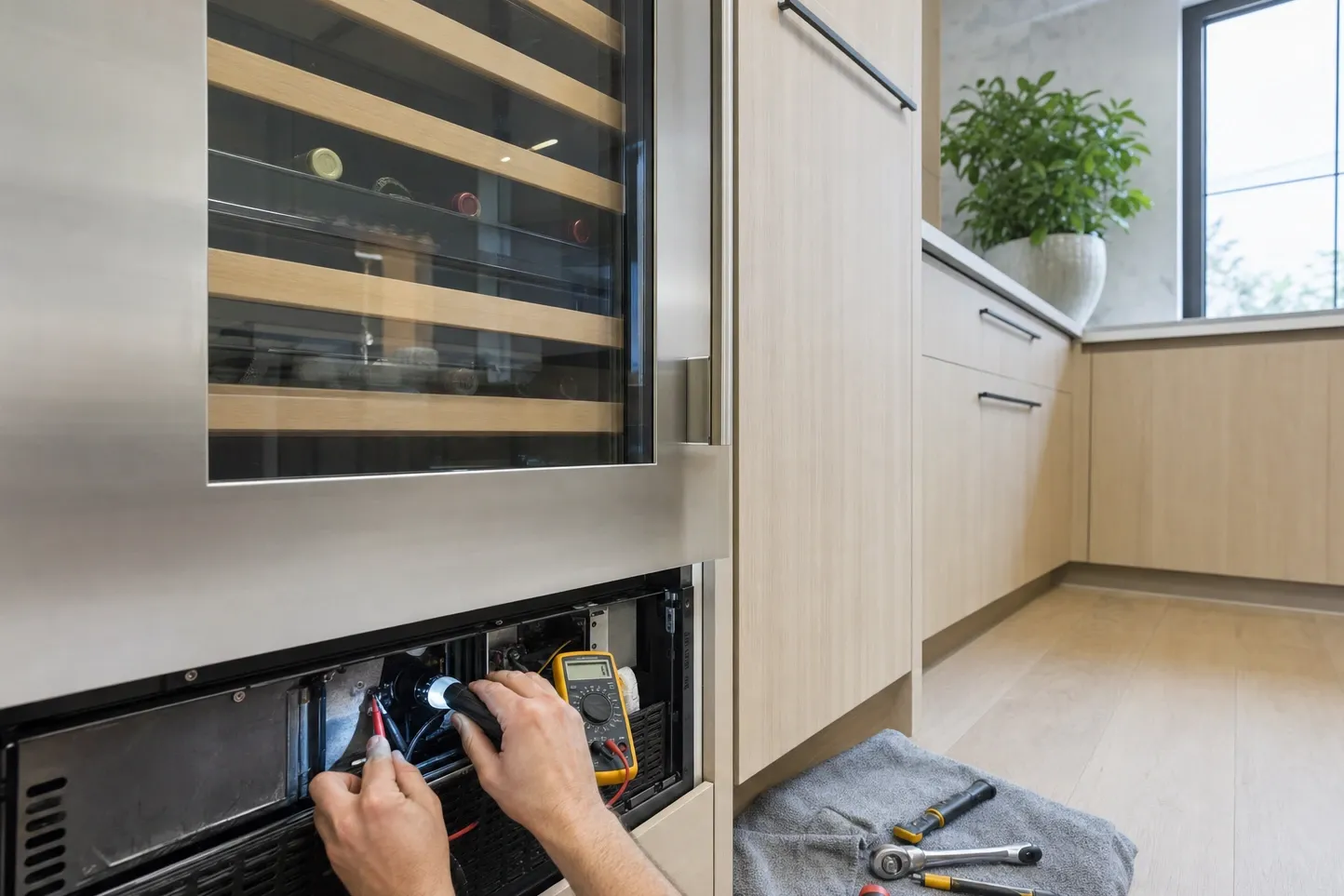
Two fronts that lined up the week the kitchen was signed off, and do not line up now. Usually it shows on one edge: a panel sitting a fraction low against the drawer beside it, or two doors whose handles were level once and are no longer. Nobody has done anything to the appliance. It simply stopped agreeing with the run around it.
What the complaint looks like from two paces back
The eye is very good at this and very bad at explaining it. What you are seeing is a horizontal line — the top of the doors, or the bottom edge of a run of fronts — with a step in it at the appliance. On a long unbroken run the step is obvious; in a galley it reads instead as a shadow on one side of the cabinet and none on the other.
Before assuming anything, look at both vertical gaps beside the appliance front, top and bottom. A gap that is even at one end and pinched at the other is telling you the door has rotated. A gap that is even but simply wider on one side than the other is telling you the whole front has been hung off-centre. Those are different faults with different fixes.
What a refacing does to fixings set once
This is the common one, and it is nobody’s fault in particular. Around Toluca Lake and Burbank there are a great many kitchens from the 1930s and 1940s that have been reworked around the built-in rather than replaced with it, some of them more than once. Each refresh means the fronts come off and new ones go on.
The trouble is that the hardware holding a custom front was positioned once, at installation, and then left alone for years. When a panel is removed and a replacement offered up, the new piece is rarely identical: a different thickness, a millimetre more here, a rebate in a different place. The fixings go back into holes that have already been used, and a screw returning to an old hole will happily find the old position rather than the new correct one.
The result is a front that is very nearly right, hung on hardware that has lost a little of its grip, above an appliance door nobody re-levelled because it is not a cabinet door and was not on anyone’s list.
Timber moves, and finish arrives late
A new front is made in a workshop and lives in a kitchen, and those two rooms are rarely at the same humidity. A wide panel takes up or gives off moisture for weeks after it is hung, and it moves while it does. In the flat valley heat out towards Tarzana that settling happens faster and further than anyone expects.
Then there is finish. A door that is hung bare and sprayed or oiled afterwards weighs more at the end of the week than it did when the hardware was set, and the extra sits entirely on the outer edge. Neither of these is a defect. Both are reasons a front that was true in March is a shade out by June.
Did the appliance move, or did the cabinetry?
Measure against the carcase, never against the neighbour. The neighbouring door is exactly as likely to have shifted as yours, and comparing two moving things answers nothing.
Stand square on and read the gap between the appliance front and the fixed upright beside it, at the top and again at the bottom. If that gap is consistent while the neighbouring front is out of line, the cabinetry moved and the appliance is innocent. If the gap itself tapers, wide at one end and closed at the other, the door or its panel has dropped and it is the appliance side that needs attention. Do the same on a run of two side-by-side units before deciding which of the pair is at fault.
What an adjustment recovers, and what it does not
A good deal, as it happens. Drift in the door on its hardware, a front that has slipped a little on its fixings, a seal no longer meeting the frame squarely because of either: all of that is recoverable in the room, with the cabinet where it is and the joinery staying put.
What an adjustment will not survive is a load the hardware was never given, or a fixing hole that has been opened out by a third round of screws. In the first case the front needs to be lighter; in the second the panel needs fresh, sound fixing points, which is a job for whoever made it. If you are not sure which of those you are looking at, describe the gaps top and bottom to Sub-Zero Repair Service Los Angeles on (310) 499-2240 — that description plus the $89 visit is usually the whole diagnosis.
Follow-ups
- The gap looks fine when the doors are shut. Should I still bother?
- Yes, if the line is visibly broken when you stand back. A front out of position by a small amount is cosmetic; a front out of position because the door beneath it has moved is the early stage of a seal that stops touching in one corner, and that one does not stay cosmetic.
- Can the cabinetmaker who fitted the kitchen put it right?
- For the panel on its fixings, often yes, and that is the right call. For the appliance door itself there is separate adjustment built into the hardware, made for the load it carries, and it is worth having the two looked at together rather than each trade correcting the other in turn.
- How soon after a refit does this usually show?
- Not on the first day, which is what makes it confusing. It tends to appear once the fronts have lived through a few weeks of ordinary use and the room has run through its own cycle of warm afternoons and cool evenings, by which point the refit feels long finished.