Valley Heat, City Water 3 of 3
Wine Column Off Setpoint: Reading Zone Drift, Sweating Glass and Frost
Written by
Elena Sandoval
Refrigeration technician — cabinet, door and seal work · 24 years in the trade
Checks seal geometry and door closure first on a warm-cabinet call. A unit fighting a poor seal all day makes the sealed system read badly, and the readings only mean anything once the door is closing the way it was built to.
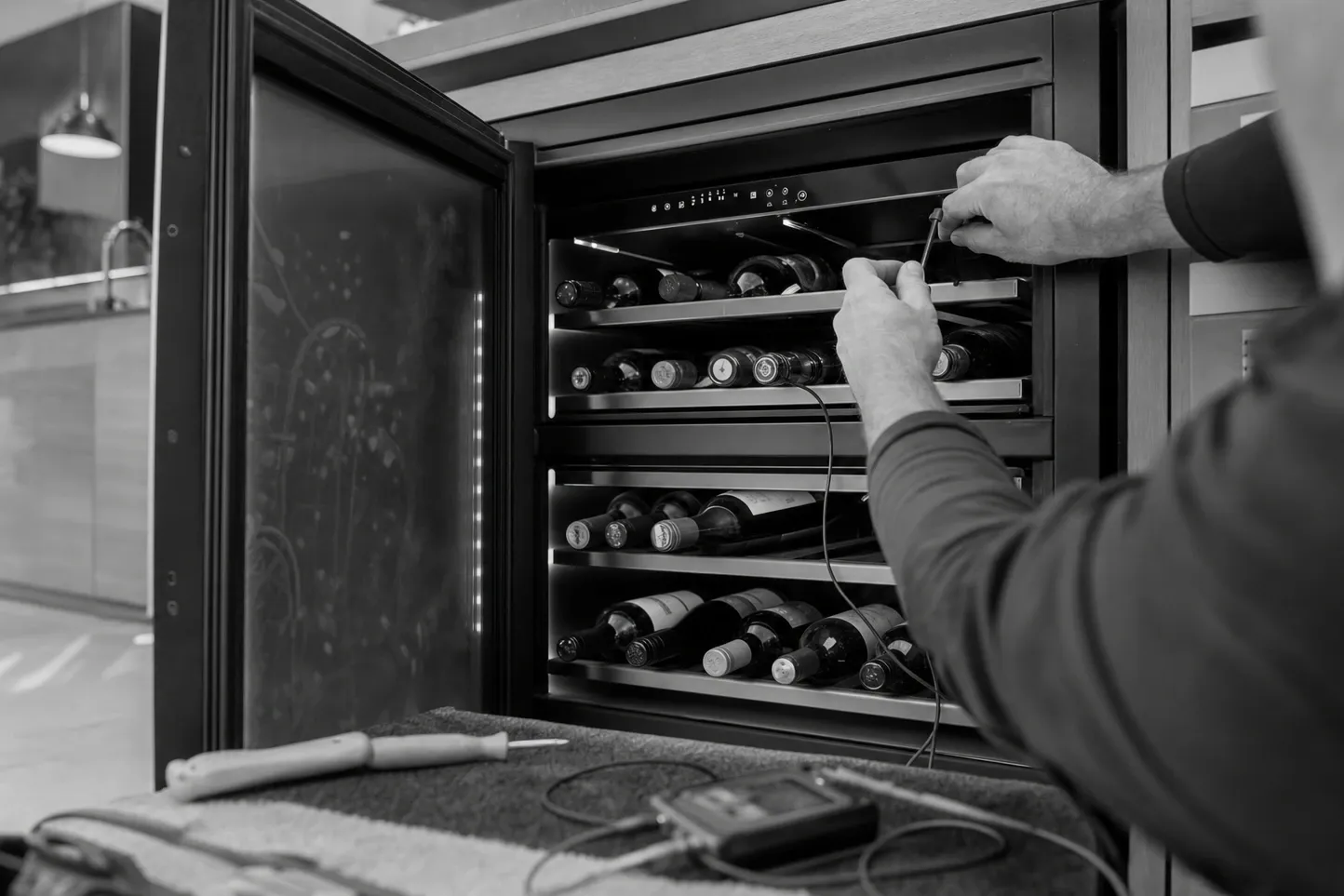
A wine cabinet is the least forgiving appliance in a Los Angeles kitchen, and the one people leave the longest. A refrigerator that drifts announces itself with soft ice cream. A wine column drifts silently for months, and the first sign is usually a bottle that tastes tired at a dinner where it mattered.
The good news is that these cabinets fail in a small number of readable ways. Almost everything that goes wrong on a Sub-Zero wine unit falls into one of four buckets: the zone control and its sensors, the door and its seal, the air around the cabinet, or the condenser and its fan. Each one has a signature you can read before anyone is dispatched.
What drift looks like on a dual-zone cabinet
Start by separating the two zones in your head. A dual-zone column runs an upper compartment warmer than the lower one — reds above, whites and sparkling below, in whatever configuration the setpoints were left at.
Put a separate thermometer in each zone, on a shelf rather than against the rear wall, and leave it for a few hours. Then compare:
| what you see | what it usually means |
|---|---|
| one zone steady, the other three or more degrees off | that zone’s sensor or its damper, not the compressor |
| both zones drifting up together, worst in the afternoon | heat around the cabinet, or the condenser |
| both zones slowly converging on one number | the divider damper or the control |
| a zone that swings wide, then recovers, then swings again | a sensor reading intermittently, or a poor connection |
Notice what is not on that list: refrigerant. A cabinet that is genuinely short of charge does not hold either zone, at any hour, in any weather — and it will usually run continuously while failing to do it. That is a different diagnosis and a different conversation.
The panel display is a reference, not evidence. On a cabinet that has been running for years, the display and the actual shelf temperature can differ by several degrees, and the difference is itself a clue: a control that thinks a zone is at fifty-five while a probe says fifty-nine is a control being lied to by its sensor.
Condensation on the inside of the glass
This is the most commonly ignored fault on wine storage, and the most useful one to catch early.
Glass on these doors is insulated, so it should not sweat on the inside. When it does, warm, humid room air is finding its way in and meeting cold glass. Somewhere the door is not pulling onto its seal. Three usual reasons, in order:
A tired gasket. The seal on a wine door lives a hard life — it is opened more often than a freezer, and the flexible section takes a set over the years. Run a hand around the closed door and feel for a cool line, or close the door on a sheet of paper and check that it grips at every point along the run.
A dropped hinge. A loaded wine column is heavy, and the door carries bottles too. A hinge that has settled a few millimetres leaves the top or bottom corner standing slightly proud. You can often see it: the gap along the frame is wider at one end than the other.
A latch that no longer pulls. From a hand-width open, the door should draw itself onto the face and stay there. If it needs a push, the latch is worn and the seal is only touching, not sealing.
None of the three is an expensive repair, and all three cause the same expensive symptoms if they are left: high humidity, labels marking, a compressor running far more than it should, and eventually ice where the moist air condenses and freezes.
Frost at the back of the lower zone
Frost on the bottles at the back of the lower compartment feels like the opposite problem, but it is usually the same one a stage further on.
Moist air is getting in. The evaporator pulls that moisture out of the air, and it freezes on the coldest surfaces it can reach — the rear wall, the coil housing, and the shoulders of the bottles nearest to them. Meanwhile the control, seeing a zone that never quite settles, runs longer and colder. The cabinet ends up simultaneously too cold at the back and not cold enough in the middle.
Two other causes worth ruling out:
- Bottles loaded against the rear wall. These cabinets need an air path behind the racks. Packed hard to the back, the air stops circulating and the nearest bottles freeze while the rest of the zone drifts.
- A sensor in the wrong place or reading badly. If the control’s probe sits where air is warmer than the shelf average, everything else gets overcooled to satisfy it.
Heat the cabinet cannot get rid of
Undercounter wine units in Los Angeles kitchens fail from heat far more often than from age, and it is nearly always an installation story rather than a component story.
The machine takes in air at the toe kick, passes it over the condenser, and pushes it back out into the room. If a remodel closed off part of that path, or built the unit into a run with no gap, the exhaust gets drawn straight back into the intake. The unit then breathes its own hot air, the coil never sheds heat, and the cabinet cuts out on hot afternoons and behaves perfectly overnight — which makes everyone assume the appliance is fine.
Check it with your hand. With the unit running, hold a palm at the toe kick. Air should be moving out and it should be warm, not hot, and you should not feel it being pulled straight back in beside it. In a Beverly Grove galley or a Windsor Square butler pantry this is where a surprising number of wine calls end up: a plinth vent that needs opening, a coil that needs clearing, and a condenser fan that has been failing quietly for a year.
What to check before you call
- Put a separate thermometer in each zone for a few hours and note both readings alongside the setpoints.
- Close the door from a hand-width open and watch whether it seats itself.
- Look along the door frame for an uneven gap, top to bottom.
- Feel the glass on the inside for damp, and look for frost on the rear wall of the lower zone.
- Hold a hand at the toe kick and note whether air is moving.
- Note the weather and the time of day when it misbehaves. A fault with a schedule is a fault with a cause.
Bring those six observations to the phone and the visit starts with a meter in the right place. The flat $89 pays for the trip and the whole diagnosis; the figure for putting it right is agreed with you first, and on a wine cabinet that figure usually belongs to a seal, a sensor, a latch or a fan rather than to anything dramatic.
Follow-ups
- How far off setpoint is actually a fault?
- A degree or two of swing through a cycle is normal and harmless. A zone sitting three or more degrees off its setpoint all day, or a cabinet whose two zones have quietly converged on the same number, is a fault worth diagnosing rather than living with.
- Is condensation inside the glass door dangerous for the wine?
- The water itself is not the problem — the reason for it is. Condensation means warm, moist room air is reaching cold glass, which means the door is not sealing. That same leak drives humidity up, invites label damage and mould, and makes the compressor run far longer than it should.
- Why would the bottles at the back of the lower zone be frosty?
- Because the cabinet is overcooling to compensate for something. Air leaking in at the door, or a sensor reading warmer than the zone really is, makes the control run the evaporator harder — and the bottles closest to the cold air pay for it.