Valley Heat, City Water 1 of 3
Why a Sub-Zero Struggles Through a Hundred-Degree Valley Afternoon
Written by
Elena Sandoval
Refrigeration technician — cabinet, door and seal work · 24 years in the trade
Checks seal geometry and door closure first on a warm-cabinet call. A unit fighting a poor seal all day makes the sealed system read badly, and the readings only mean anything once the door is closing the way it was built to.
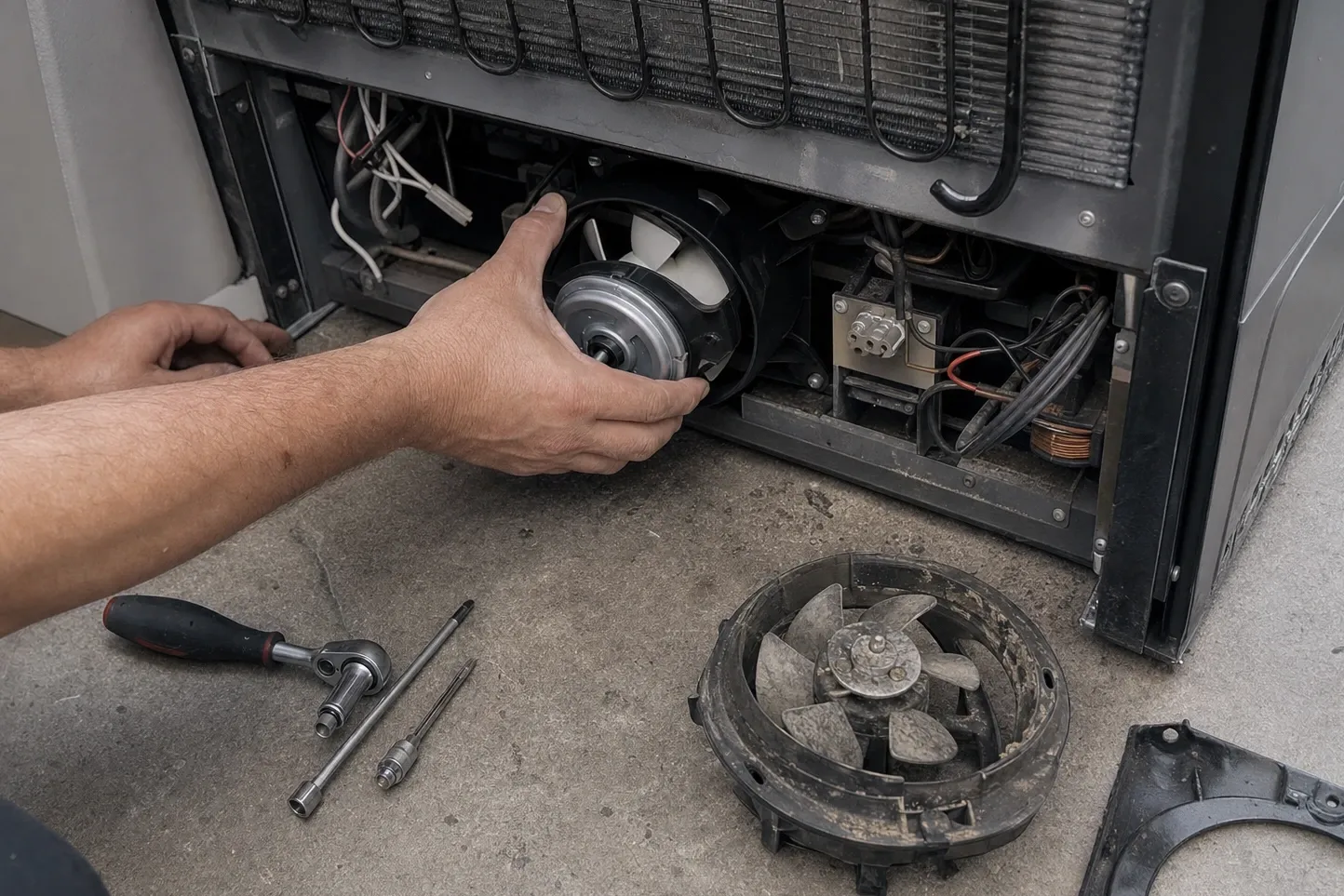
Every summer the same call arrives from Tarzana and Toluca Lake within a few days of each other. The built-in has been faultless for years. Then the valley sits above a hundred for a week, the fresh-food compartment climbs into the fifties by late afternoon, and by ten at night it has quietly recovered. Nothing is leaking, nothing is broken in the obvious sense, and the cabinet will do it again tomorrow.
That pattern — fine in the morning, poor at four in the afternoon, fine again overnight — is almost never a refrigerant problem. It is a heat-rejection problem, and it has a short list of causes that can be worked through in one visit.
What “struggling” actually looks like on a hot day
The tell is the shape of the day rather than the temperature itself.
A cabinet short of refrigerant is poor all the time. It does not recover at night, the freezer side suffers alongside the fresh-food side, and the compressor runs continuously without ever reaching setpoint. That is a sealed-system fault, and it does not care what month it is.
A cabinet that cannot reject heat looks completely different:
- it holds fine in the cool of the morning
- it drifts up through the afternoon, worst around the time the kitchen is hottest
- the compressor stops cycling off — it is running, and running, and getting nowhere
- the air coming off the grille is noticeably hot, and so is the cabinetry beside it
- overnight, once the room cools, everything comes back to normal and the display looks smug
If that is the pattern in your kitchen, the fault is on the outside of the system, not inside it — which is good news, because the outside is where the cheap repairs live.
Where the heat is supposed to go
Nothing inside this machine manufactures cold. Heat is collected from the compartments and carried out into the kitchen, and on a built-in the entire hand-off has to happen through one louvred band in the face of the cabinet. There is no back to breathe out of, the way a freestanding unit has.
Find yours before you look for anything else, because it is not in the same place on every cabinet. On a Classic full-size unit the grille runs across the top, above the doors — Sub-Zero photographs it there and calls it the emblem of the range. On a column panelled to match the joinery, and on anything undercounter, it is at floor level instead, behind a kickplate that may be finished to look like the rest of the run.
Wherever it is, the sequence is the same: air is drawn in through the louvres, pulled across the condenser coil by the condenser fan, and pushed back out into the kitchen. The coil is where the refrigerant gives up the heat it collected inside. Everything about that job depends on two things: how much air moves, and how much colder the room is than the coil.
On a mild day there is enormous margin. The coil can be half-blocked and the fan can be tired and the cabinet will still hold zero on the freezer side, because the room is doing most of the work for it. In a hundred-and-five-degree kitchen there is no margin at all. Every deficiency that was invisible in February shows up at once, and it shows up as a warm compartment.
This is the single most useful idea to hold on to: summer does not break these cabinets. Summer reveals what was already wrong.
The four things that go wrong in a valley kitchen
In the order they turn up on site:
A condenser that has become a felt mat. Take the grille off in a hillside house in Tarzana after a few dry seasons and the coil is often a solid grey pad — construction dust, hillside grit, pet hair, whatever the air brings. Air cannot get through it, so the coil cannot dump heat, so the compressor runs longer, so the compartment drifts. A careful clean, coil fins respected, and the machine is often back to itself.
A condenser fan that has slowed or stopped. These motors do not usually fail dramatically. They lose speed, or a bearing starts to drag, or the blade catches its shroud and the airflow halves. A fan that still turns can absolutely be the fault, which is why airflow is measured rather than eyeballed.
An air path a remodel closed off. This is the Los Angeles special. A kitchen gets refinished, a joiner makes the face of the run flush and beautiful, and the louvres that fed the condenser end up behind a decorative panel. Or an undercounter unit ends up in a run of cabinetry that recirculates its own exhaust straight back into the intake, so the machine slowly cooks itself. It looks perfect and it strangles the appliance.
A control that is reading its environment badly. Less common, but a temperature sensor that has drifted, or a control board mishandling a defrost cycle, produces a cabinet that behaves strangely under load and behaves fine when the load is light.
Only after all four of those come the sealed-system possibilities: a partial restriction, a weak compressor, a charge that really is low. They are diagnosed with gauges and a clamp meter, not by elimination — and if that is the answer, it changes the conversation about whether the cabinet is worth keeping.
What you can check before the visit
None of this is a repair, and none of it requires tools you do not already own. It does make the first visit shorter.
- Measure the air, not the display. Put a thermometer on the middle shelf of the fresh-food compartment and read it in the late afternoon, then again at seven in the morning. A ten-degree difference between those two readings tells a technician more than a week of door-display screenshots.
- Find your grille, then look through it. The louvred band above the doors, or the kickplate at the floor — whichever your cabinet has. Hold a torch to it and look for light through the coil. If none comes through, say so on the phone; that changes what gets loaded on the van.
- Listen for the fan. With the compressor running you should hear steady air movement in the machine compartment. Silence, or a rhythmic tick, is worth reporting.
- Note whether it ever cycles off. A cabinet that never stops running is working flat out and losing. That single observation rules out half the fault tree.
- Remember the remodel. If anything was done to the cabinetry, the flooring or the plinth in the last few years, mention it. It is astonishing how often that is the whole story.
When it is not the heat at all
Two patterns look like heat load and are not.
If the fresh-food side is warm while the freezer stays hard frozen, the problem is the hand-off between the two compartments — a stalled air damper, an evaporator fan icing up, or a defrost cycle that has stopped clearing the coil. Ambient temperature is a red herring there, and the repair is inside the cabinet rather than behind the grille.
If the drift began suddenly on a normal day, or the cabinet has been poor for weeks regardless of weather, treat it as a system fault and get it looked at rather than waiting for the next heatwave to make the pattern obvious. A compartment sitting in the fifties for a few days is a food-safety question before it is a refrigeration question.
The flat $89 visit exists for exactly this: readings first, an honest description of what they mean, and a price for the work before anybody starts. In a hot summer the answer is usually a clean coil, a new fan and a vent that can breathe again.
Follow-ups
- Is a warm refrigerator in summer always a refrigerant problem?
- Rarely. A sealed system either has its charge or it does not, and a leak does not wait for July. A cabinet that holds temperature in March and drifts in July is almost always failing to reject heat — a matted condenser, a fan that has slowed, or an air path a remodel closed off.
- How hot is too hot for a built-in kitchen?
- These cabinets are designed for a normal room, not for an enclosed galley sitting in the high nineties with an oven running. The machine can usually cope with a hot day; what it cannot cope with is a hot day plus a dirty coil plus a grille that has been panelled over.
- Does cleaning the condenser myself fix it?
- Now and then, yes, and a careful pass with a soft brush and a vacuum once the grille is off is worth the ten minutes. What no amount of brushing touches is a fan that has lost speed, a dragging bearing or an air path a remodel closed off — those come back the following week.